Trade union movement reacts to Keir Starmer’s resignation
PM's decision to step down means the UK will soon have its seventh Prime Minister since 2016.
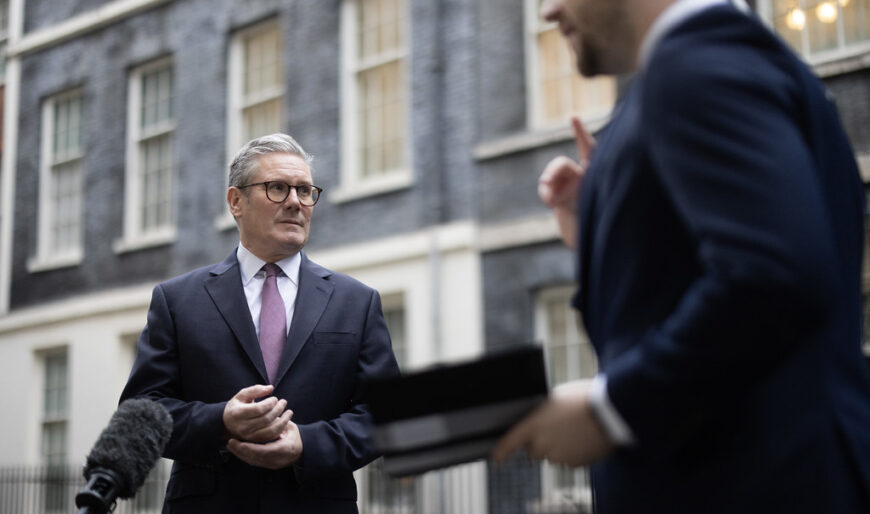
Prime Minister Keir Starmer has announced his resignation this morning. He gave a speech outside Number 10 Downing Street, saying that he’d listened to the Parliamentary Labour Party about who was best placed to take the country forward in the wake of poor local election results and polling over the last year, and therefore intended to resign as PM, with an “orderly transition” to a new Leader of the Labour Party, and Prime Minister.
Starmer has asked the National Executive Committee of the Labour Party to set out a timetable with nominations opening for the leadership on the 9th July, and completed by the summer recess. This will mean a new leader is in place before Parliament returns in September.
Ex-Manchester Mayor Andy Burnham has confirmed that he is intending to stand for the leadership, whilst Wes Streeting has declared that he will not stand. It is not yet clear whether there will be a contest – that will depend if anyone other than Burnham seeks nominations and is succesful in achieving the threshold.
Trade union leaders have been reacting to Keir Starmer’s announcement throughout the day. Sharon Graham, general secretary of Unite, said:
Keir Starmer’s decision to resign was the honourable and right decision.
It is critical now that Labour focuses on delivering for workers and communities.
There is no time to waste, everyday people are literally on their knees. Labour has one last shot to learn from the errors of the last two years. A failure to act, will result in a doomsday scenario for Labour.
In the short term we need policies that make workers’ lives easier. There must be action to end the freeze on tax thresholds, reversing the fiscal drag, that has pulled workers into unfair tax bands.
Action must be taken immediately on the energy price cap, bill payers are paying hundreds of pounds to profiteers every year, that must end.
There must also be immediate action on industrial strategy, with investment in jobs and industry. That investment must be made now and not at some far off point in the future.
Given that a contest looks unlikely, we need to move swiftly to policy discussions so the political and economic direction is clear.
Unison general secretary Andrea Egan said:
The next Prime Minister has an opportunity to break with tinkering around the edges and deliver a complete transformation of this country, permanently shifting wealth and power to working class people.
That means full implementation of the plan to Make Work Pay, a massive programme of public investment and insourcing to repair our public services, and national public ownership of utilities.
Schools, hospitals, councils and transport – and the public service heroes working in them, keeping our country running – must be the fiscal priority, not the military and foreign wars.
Breaking with the failed approach of the current Labour government also requires standing up to the migrant-bashing of the far-right rather than imitating it.
If the next Labour leader doesn’t enact this kind of generational programme, the consequences will be dire for us all, as Farage and his failed-Tory cronies wait in the wings.
ASLEF general secretary Dave Calfe said:
Keir Starmer’s resignation is the correct decision. We now need a PM and Labour leader who will work with trade unions to deliver the New Deal for Working People in full. They must ensure that Great British Railways delivers for passengers and workers, and secure the future of rail freight.
Reflecting on Keir Starmer’s leadership and looking forward to the future, Joanne Thomas, general secretary and TULO chair at retail union Usdaw, commented:
Keir Starmer has made an immense contribution to our movement and we will always be grateful to him for turning around the Labour Party, after its worst defeat in living memory.
Under his leadership, Labour has delivered the biggest-ever uplift in workers’ rights and substantial legislation to tackle retail crime and help prevent violence, threats and abuse against shop workers. That is the change that Usdaw campaigned for and our members supported.
As the prime minister said in his speech, the question now is who is best placed to take the country forward and best placed to deliver a Labour victory at the next general election. That is why it is right that he has sought to set out a timetable for a departure.
Transport union RMT, has called for the Labour government to radically change course. Speaking from the union’s AGM in Liverpool, Eddie Dempsey, RMT general secretary said:
Andy Burnham who has declared his intention to stand for the vacancy in 10 Downing Street, said this Labour Government has one ‘last chance to change’ and to ‘end trickle down economics.’
We agree and that means intervening in the economy to expand public ownership, to raise wages, improve living standards and for the state to intervene to help working class people, not hang them out to dry at the mercy of market forces.
Only by working with trade unions, radically improving the lives of ordinary people and securing the economy to serve them, can the Labour government have any hope of winning the next general election.
The new Prime Minister will need to seize the opportunity to make Great British Railways a success by speeding up its roll out and ending the scourge of outsourcing. Our members will expect nothing less.
Maryam Eslamdoust, general secretary of TSSA said:
Keir Starmer did the decent thing by resigning before he was forced to. The Labour Party now has an opportunity to pivot to the policies this country and working people desperately need.
Wages don’t stretch far enough, our infrastructure is crumbling and living standards have stagnated after the long years of Tory austerity.
Britain needs a renewed focus on rebuilding the country under a Labour government which has the drive and determination to truly change millions of lives through social and economic justice. There is not a moment to lose.
FBU general secretary, Steve Wright said:
Whoever replaces Keir Starmer needs to be clear that the status quo has to change. The reason we find ourselves with yet another PM standing down is that, like May, Johnson, Truss and Sunak before him, Starmer failed to break with the perceived wisdom of attacking public services, failing to tackle wealth inequality, whilst letting privatised public utilities rip off the people of this country. A new Labour leader needs to learn that lesson and learn it fast.
For FBU members, this means stepping in to end the threat of fire station closures that puts our members and the public’s lives at risk. There needs to be investment in the fire and rescue service alongside other public services, and as an affiliated trade union, we will be putting that position before any candidate in a leadership election.
We cannot have more of the same. If we do, then whoever is elected will inevitably have failed in their role and will be out of office at the earliest opportunity. The chance to break with the narrative of the past is now, learn the lessons that previous Prime Ministers failed to do and deliver a better future for our members and the people of this country.
Daniel Kebede, general secretary of the National Education Union, said:
The country had seen enough of Keir Starmer’s government to know that it is not going to deliver the meaningful change that was promised by Labour two years ago.
Polling released by the NEU this weekend shows that only 5% of NEU members think that the Government have performed well on education over the last two years.
Keir Starmer was wrong to claim credit today for ending austerity. Part of the reason why his Government is so deeply unpopular is that they have failed to fix the funding crisis in schools, which risks condemning another generation of children to bear the brunt of austerity-level school budgets.
If we have more of the same from our next Prime Minister, we risk sleepwalking into the disaster that would be a Reform UK government. The stakes could not be higher. Whoever does replace Keir Starmer needs to set Britain on a different economic path and deliver fundamental change. That change must start with our schools and colleges.


Related news
Transport for London urged to ensure London drivers are ‘not left behind’ by driverless cars.

UVW launches campaign spotlighting exploitation of London’s essential workers