Government publish regulations on new duty on employers to inform workers of their right to join a trade union
The standardised statement which must be used by employers to inform workers of their rights
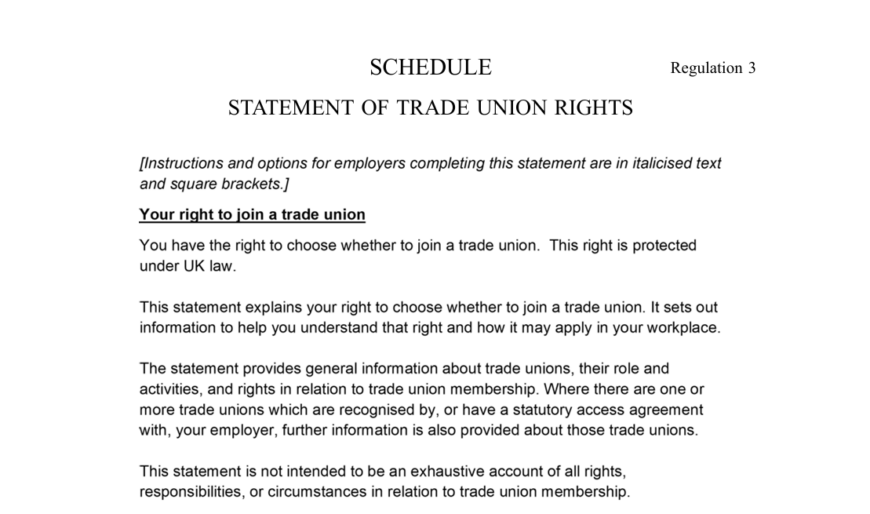
The government has published regulations on the new duty on employers to inform workers of their right to join a trade union, confirming that the duty will apply to all employers from 1 January 2027.
The standardised statement which must be used by employers to inform workers has also been published separately.
Anyone starting work on or after 1 January 2027 must receive the statement at the same time that they receive their section 1 statement. Existing employees must receive the statement on or before 5th April 2027.
On the GOV.UK website, the Government state:
‘You must provide workers in Great Britain with a statement informing them of their right to join a trade union. This is to comply with section 136A Trade Union and Labour Relations (Consolidation) Act 1992 and the Statement of Trade Union Rights Regulations 2026.
From 1 January 2027, you must give the statement to new workers alongside the written statement of employment particulars.
By 5 April 2027, you must give the statement to existing workers (those employed immediately before 1 January 2027).
From 6 April 2027, as well as giving the statement to all new workers at the same time as the written statement of employment particulars, you must also give the statement to your other workers, or remind them of its availability and location, by 5 April each year. There are different ways employers can meet this annual requirement which are explained in the following guidance.
Preparing a statement to inform workers of their right to join a trade union
You must use the standardised statement to inform workers of their right to join a trade union. You must not add further information to, or change the statement, except where the regulations require or permit this, as outlined in the following sections.
Recognised trade unions
If you recognise trade unions
Where the employer recognises one or more trade unions, the recognised trade unions section of the statement must include:
- the name of each trade union recognised by the employer for the purpose of collective bargaining – employers must include all trade unions recognised across their organisation, even where a particular recognition agreement does not cover the worker receiving the statement
- a summary of the worker categories and workplace locations covered by each recognition arrangement. The summary should help workers to identify the worker groups and workplace locations covered
- at least 2 contact details for each recognised trade union, where these have been provided by the union. These may include a general telephone number, a general email address, or a physical office location (such as a physical room at an employer) or address of the trade union
You are encouraged to discuss with the relevant recognised trade unions how best to reflect the recognition arrangements in the statement.
Preparing the recognised trade union contact details
You should request the relevant contact details from the union. Where the union does not provide them, the employer should omit those contact details from the statement.
Recognised trade unions are encouraged to provide these contact details within a reasonable time following a request from the employer. Where a new recognition arrangement is reached, recognised trade unions are encouraged to provide the contact details within 14 days of the recognition being arranged.
The trade union must ensure that the contact details do not include personal contact information, such as the name of an individual.
You may agree with a recognised trade union to provide different general contact details of that union to different groups of workers, where appropriate. For example, workers in different regions could be given contact details for their relevant regional union office. This approach is optional.
Where recognition is being sought but has not yet been agreed or determined, the name and details of the union seeking recognition should not be included in the statement until recognition is in place.
If you do not recognise a trade union
If you do not recognise any trade union, you must state that the employer does not recognise any trade unions for the purposes of collective bargaining.’
You can find more details here.


Related news

Government publishes revised draft Code of Practice on fair distribution of tips

Usdaw welcomes a requirement on employers to prevent harassment & grant trade union access to workplaces