Finishing the Job: Union leaders and experts say Burnham Government must go further to improve working lives
Read about our joint fringe with the Campaign for Trade Union Freedom at the annual TUC Congress
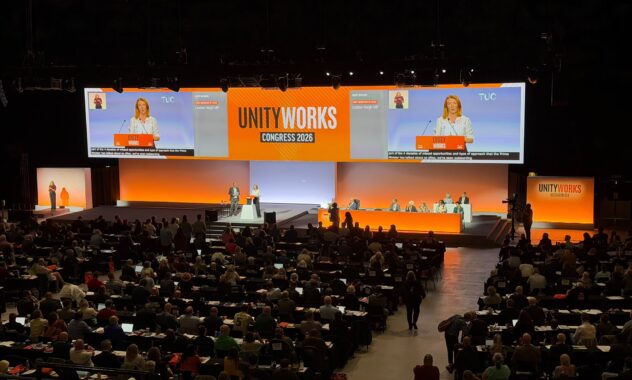
This year, we returned to the annual TUC Congress with our usual joint fringe event alongside the Campaign for Trade Union Freedom. General Secretaries from across the movement joined labour law experts in a united call for the Government to go further than the foundations of the ERA and implement the New Deal for Working People in full. Doing this, they argued, will require the reintroduction of sector wide collective bargaining, the introduction of a single status of worker and lifting the ban on taking solidarity action.
The Right to Strike
Steve Gillan, General Secretary of the POA, led the discussion on rolling back restrictions on the right to strike for his members. The ban on prison officers taking industrial action is, he says, held in place by a pernicious piece of legislation that has no place still standing in 2026. For 32 years, he told us, successive governments have breached international law, including the standards set by the ILO and the European Social Charter.
Giving prison officers the ability to take industrial action is not unprecedented, indeed Scottish prison officers do have such a right, yet they have never once needed to hold a statutory ballot, Gillan told us, instead using that right as leverage to improve pay and conditions.
Zero Hours Contracts:
General Secretary of USDAW, Joanne Thomas, says that the intial promise of guaranteed hours had the potential to give real security to millions of the most vulnerable and low-paid workers. She says that the provision must be free of loopholes and opportunities for exploitation from employers – the right must be absolute and guaranteed for all workers. You can watch her full speech below.
Despite the issue largely not affecting POA members, Steve Gillan joined other leaders on condemning the lack of commitment to abolishing zero-hours contracts in the ERA. “The reality is, Labour need to choose the path of what was in the manifesto, without watering that down” he said.
Trade Union Access Rights:
Professor Keith Ewing pointed out worrying holes in the ERA 2025, especially over access ‘rights’, As the Act gives unions the right to request access agreement, as opposed to rights of access. You can watch a clip from his speech, including his analysis of the Government’s access procedure, below.
Joanne Thomas added that a right to strike and sectoral collective bargaining is reliant on expanding the trade union base and allowing unions to have access to workers in their workplaces. “An access right should open doors that have been firmly shut before…the watered-down version of access that we’re getting isn’t what it should be.” She calls for proper penalties where employers unlawfully block unions from using the access provisions.
Sectoral Collective Bargaining:
Fran Heathcote says that while the Government has ‘talked the talk’ on widening collective bargaining coverage in the UK, they have not gone on to walk the walk. The ERA only attempts a version of sectoral collective bargaining in two areas, adult social care workers and teaching assistants. Fran Heathcote makes the point that the Government must introduce collective bargaining in its own ‘back yard’, the Civil Service. You can watch her speech above.
Sector wide collective bargaining is fundamental to our movement, says Andrea Egan, general secretary of UNISON. “We know from our history, and from other European Countries, that sectoral collective bargaining allows workers to challenge the inequalities of power that occur in a capitalist system.” If Labour want to bring down equality, she says, this is where the Government must start.
This point is elaborated on by our Chairperson, Lord John Hendy KC, who says that the demand for sector wide collective bargaining is indeed the single most important one for the trade union movement currently. “It is the absence of sector wide collective bargaining that has led to the fact that we now have a cost of living crisis where millions of workers don’t have enough money to put food on the table and to clothe their children.” If Andy Burnham wishes to fix the cost of living crisis, he said, the only way to do it is with wide reaching sectoral collective bargaining.
Single Status of Worker:
“We have to do something urgently about single status of workers” says Dave Ward, General Secretary of the CWU. The union movement has been lacking a unified view, he told the room. He explains that CWU members who work for Royal Mail are particularly affected by a practise of utilising bogus self-employment to squeeze workers of their rights and pay on a daily basis. The Union movement, he concluded, needs to commit against making sweetheart deals, in favour of unity. You can watch his contribution below.
Reversing decline:
Professor Ewing closed our fringe with the stark figures of trade union membership and bargaining coverage decline in the UK since the 80s. “It cannot be acceptable” he says “that in the UK only 1 in 5 workers are members of a trade union, and only 1 in 4 is covered by a collective agreement. These are the second worst number in Europe, that we cannot go on without addressing properly”.
Thank you to all who attended this fringe, you can access clips from our events on our social media or YouTube channel (found here).
We would also like to extend our thanks to all speakers who featured on the panel, and to Sarah Woolley (BFAWU) for chairing the event.
Speakers:
Joanne Thomas, General Secretary USDAW
Dave Ward, General Secretary CWU
Professor Keith Ewing, President of the IER
Fran Heathcote, General Secretary PCS
Neil Todd, Thompsons Solicitors
Andrea Egan, General Secretary UNISON
Lord John Hendy KC, IER Chairperson
Steve Gillan, General Secretary of the POA


Related news
TUC unions unanimously back the call for a Second Employment Rights Bill
TUC: Fair Pay Agreement will be vital building block in delivering National Care Service