TUC unions unanimously back the call for a Second Employment Rights Bill
Unions have call on the govt to implement the Employment Rights Act in full and introduce further legislation to strengthen workers rights.
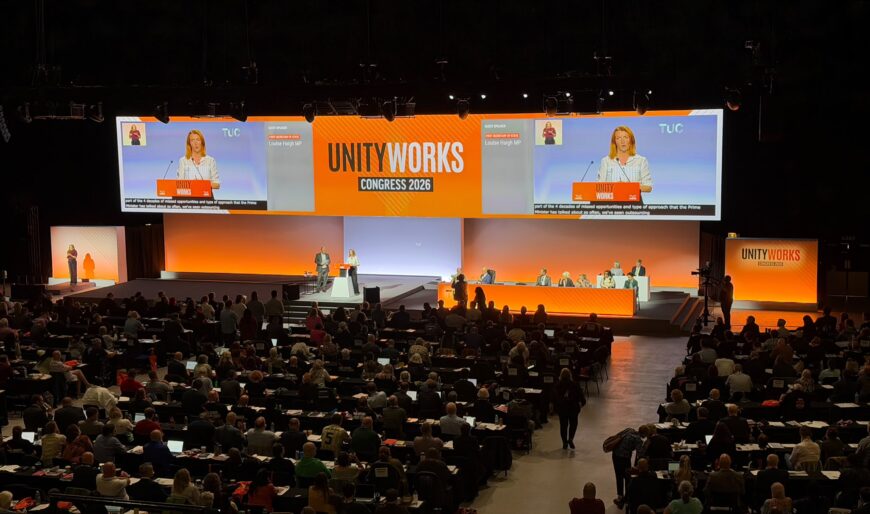
Delegates at the TUC Congress in Brighton have unanimously supported a motion which demanded that the Employment Rights Act is implemented in full, with “strong, enforceable regulations”, as well as a Second Employment Rights Bill, that “introduces genuine sectoral collective bargaining, strengthens rights for all workers and addresses remaining gaps in employment protections and enforcement”.
The same motion called on the TUC to campaign for the removal of the 50% ballot threshold and “any linkage between the removal of the threshold and the implementation of e-balloting”.
The demands have been a key part of the Institute of Employment Rights work in the last five years, as it made the case for an Employment Rights Act that reflected the commitments made in the 2019 Labour Manifesto and the susbsequent New Deal for Working People. You can read our briefing on the Employment Rights Act, here.
The full text of the composite motion (C02), proposed by the NASUWT, seconded by the POA and supported by the Royal College of Podiatry, National Union of Rail, Maritime and Transport Workers and Equity reads as follows:
‘C02 – Strengthening and protecting hard won employment rights for all workers
Congress applauds the hard work, organising and commitment over many years which have helped create legislation around equalities, health and safety and employment that give us the rights we have today.
These rights have been hard won and helped to build the trade union movement we have today. We recognise the commitment and dedication of trade unionists who shaped this landscape over the years.
Congress welcomes the Employment Rights Act 2025 and notes the government’s commitment to strengthening employment rights through the ERA and recognises the opportunity to reset the balance in UK workplaces.
Congress reiterates its support for the New Deal for Working People and Labour’s commitment in that deal, that our law on industrial action should comply with the international laws which the UK has ratified including Convention 87 of the International Labour Organization and Article 6 of the European Social Charter.
Congress believes that while the Employment Rights Act represents important progress, it does not go far enough to address longstanding imbalances in labour law or to fully restore workers’ rights. It also fails to re-establish an effective industrial relations framework, or the principally significant New Deal for Working People promise, to restore multi-employer collective bargaining, in favour of complicated legislation that will struggle to attend to sectoral complexities.
Congress further believes that the effectiveness of the Act will depend on robust implementation through clear and enforceable regulations, proper resourcing of enforcement bodies and meaningful engagement with trade unions.
Congress is concerned that without this, legislative change risks failing to deliver real improvements in workplace practice.
Congress is further concerned that the continued operation of the 50 per cent industrial action ballot turnout threshold places an unnecessary and undemocratic barrier on workers seeking to exercise their rights collectively.
Congress believes that linking the removal of the 50 per cent threshold to the introduction of electronic balloting is unjustified and risks delaying the restoration of fundamental trade union freedoms.
Congress notes that State compliance with its international law obligations is a fundamental aspect of the rule of law to which Labour is committed. Congress views with concern the decisions of the supervisory bodies of the ILO that the UK is in breach of ILO Convention 87 which, as the International Court of Justice held in May, protects the right to strike. Decisions of the ILO supervisory bodies have repeatedly found that several aspects of UK industrial action law are in breach, notably the requirement to give notice of the holding an industrial action ballot, and the total ban on solidarity action.
Congress notes with equal concern the decisions of the supervisory bodies of the European Social Charter that the UK is in breach of the Charter on identical grounds. Congress expresses concern that this year the European Committee of Social Rights held that the ban on prison officers in England and Wales taking industrial action breached the UK’s obligation to comply with Article 6(4) of the Charter which it has ratified.
We always want more and we will always fight for greater rights and we will not accept any anti-trade union laws.
Congress therefore calls on the General Council to:
i. campaign for the immediate removal of the 50 per cent ballot threshold and oppose any linkage between the removal of the threshold and the implementation of e-balloting
ii. lobby government to ensure the Employment Rights Act is implemented effectively through strong, enforceable regulations, developed alongside trade unions
iii. campaign to ensure the full provisions and maximum possible protections of the ERA, including the Mandatory Seafarers Charter, apply to seafarers on all short sea international ferry routes from UK ports, including organising a campaigning event with affiliates next year coinciding with the fifth anniversary of the P&O Ferries scandal
iv. campaign for a second Employment Rights Bill, that introduces genuine sectoral collective bargaining, strengthens rights for all workers and addresses remaining gaps in employment protections and enforcement, and to ensure our laws comply with our ratified international obligations
v. proactively highlight the rights that working people have and the consequences of them being taken away, be ready to fight against any government that wants to strip people of their rights and ensure that if and when these rights come under threat, we have already planned a response not wait for it to happen.’
Matt Wrack, General Secretary of NASUWT – The Teachers’ Union, proposing the motion, said:
For much of the 20th century, despite setbacks and defeats, the trade union movement won a transformation in the world of work and in the lives of working class people through better wages, holidays and pensions.
Attacks on union rights have been central to delivering the agenda of the banks, the bosses, the billionaires; privatisation and inequality serve only to shift power to those at the top. That is why we welcomed Labour’s pledges before the last election. At last, we could have a government willing to start to turn the tide on workers’ rights.
However, trade unions still face 50% ballot thresholds. If those thresholds applied in public elections, many of the current cabinet would not even be in Parliament. We were promised that legislation to abolish that act would be introduced within 100 days of the election. So why, two years down the line, is the 50% threshold still in place?
I don’t know how ministers count 100 days but by standard arithmetic, two years is significantly beyond the timescale set out in promises to voters.
It is scandalous that the UK is in breach of various ILO conventions. It is scandalous that UK workers do not enjoy an actual right to strike, including the right to take solidarity action. This lack of rights exacerbates all the factors which create such an unequal, bleak and dystopian world offering no future for millions.
No more delays, abolish the threshold immediately.


Related news

Finishing the Job: Union leaders and experts say Burnham Government must go further to improve working lives
TUC consulation response: proposals on the school support staff negotiating body (SSSNB)