Government consult on zero hours & flexible working
Govt seeks views on reforms in the Employment Rights Act 2025 to "end one-sided flexibility".
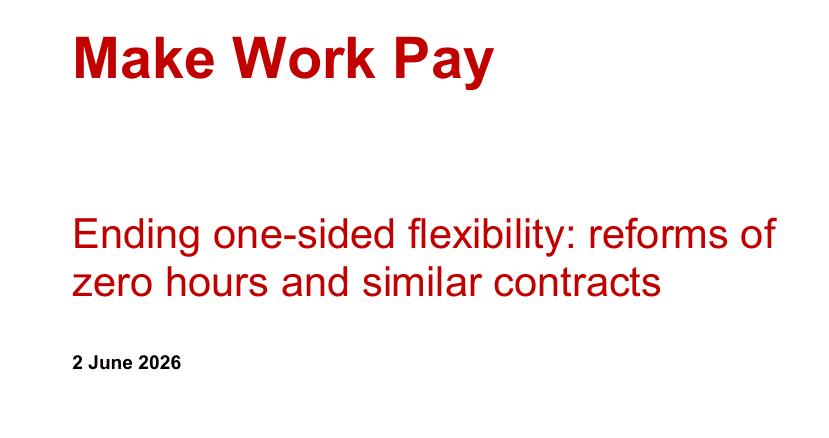
The government has launched a consultation on reforms to zero-hours and similar contracts under the Employment Rights Act 2025. Proposals in the ERA include a right to guaranteed hours based on the hours worked by a qualifying employee during a reference period, reasonable notice of shifts and shift changes, and compensation for shifts that are cancelled, curtailed or moved at short notice.
Following the consultation, which closes on 25 August, the government will develop its final policy position.
On the Government website, the consultation was introduced thus:
“The government’s manifesto committed to end one-sided flexibility and ensure all jobs provide a baseline of security and predictability.
The government has taken this forward through 3 measures in the Employment Rights Act 2025, giving employees the right to:
- guaranteed hours, where the number of hours offered reflects the hours worked by a qualifying worker during a reference period
- reasonable notice of shifts and changes to these
- payment for shifts cancelled, curtailed or moved at short notice
These measures have not yet taken effect. This consultation seeks input on details of the new rights, which will be set out in regulations.
Following consultation, the government will develop final policy positions.
We encourage everyone with a view on these reforms to answer as many consultation questions as they feel comfortable with.
We strongly encourage you to respond via the online platform. Using the online survey will assist our analysis of the responses, enabling more efficient and effective consideration of the issues raised.”
The TUC have submitted their own response, which you can read here. Policy Lead on Equality and Strategy, Alice Arkwright, said:
“We welcome the opportunity to submit to this consultation. The TUC and unions have long campaigned for greater access to good quality flexible working. It is vital for achieving gender equality, supporting carers, reducing the disability employment and pay gap, supporting older workers to stay in the workforce for longer and providing everyone with a better work life balance.
Flexible working is any change to when, where and how long people work. It can include compressed hours, flexitime, remote working, part-time work, job-shares and set shift patterns. It is vital that set shift patterns (as opposed to rolling or irregular shift patterns) are recognised as a form of flexible working – for many workers in sectors such as retail, transport and hospitality this is the primary form of flexible working requested and is vital to be able to balance work and life including care.
Flexible working consistently comes up as one of the top issues that union reps deal with in workplaces, with 60 per cent of reps telling the TUC in 2024 that they had dealt with an issue related to flexible working in the last two years 1 . We continue to find that too many flexible working requests are rejected and those who do work flexibly face poor treatment.
The provisions in the Employment Rights Act are welcome, and our response provides a trade union view on how to ensure the duty to consult process is robust, fair and consistent. We also believe that legislative change needs to go further if we are to ensure that flexible working is the default for all workers.”
More details on the consultation can be found on the Government website, here.
Ways to respond
or
Email to:
zerohours.consultation@businessandtrade.gov.uk
Write to:
Zero Hour Contracts Policy Team
Employment Rights Directorate
Department for Business and Trade
Old Admiralty Building
Admiralty Place
London
SW1A 2DY


Related news

Bakers union vows to fight for Greggs jobs
Acas Code of Practice on Disciplinary and Grievance Procedures