Acas Code of Practice on Disciplinary and Grievance Procedures
TUC consultation response by Peter Wieltschnig, Policy Lead, Employment Rights & Labour Markets & Tim Sharp, Head of Employment Rights.
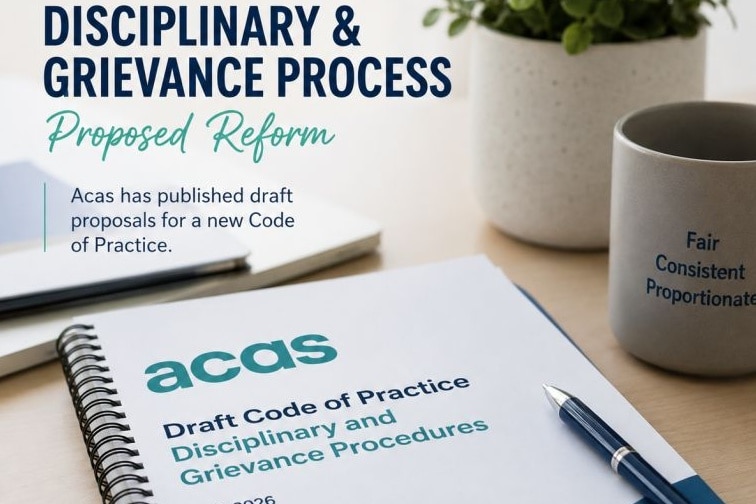
Here, we publish the introduction to the TUC response to the consultation on the Acas Code of Practice on Disciplinary and Grievance Procedures, by Peter Wieltschnig & Tim Sharp. Follow the link at the bottom of the page for the full TUC response to the consultation.
Introduction
The TUC is the voice of Britain at work. We represent more than 5.3 million working people in 47 unions across the economy. We support unions to grow and thrive, and we stand up for everyone who works for a living.
The TUC welcomes the opportunity to respond to Acas’s consultation on the draft Code of Practice on disciplinary and grievance procedures. We support the overarching objective of improving workplace relations through the earlier resolution of concerns, promoting fair treatment, and reducing the personal and organisational costs associated with unresolved workplace conflict. The recognition in the draft Code that constructive employment relations are fundamental to both worker wellbeing and organisational effectiveness is a positive starting point for this review.
Trade unions, their officials and union workplace representatives have extensive experience of representing members and helping them to resolve workplace disputes. The TUC believes that it is in the interests of all parties to resolve workplace disputes as swiftly as possible before they escalate. Where it is not possible to do this by using workplace procedures, unions will seek to defend their members’ interests by supporting meritorious claims to an employment tribunal. Trade unions have considerable experience of representing members at employment tribunals in both individual and multiple cases. The latter may involve small groups of employees or many thousands of workers.
Much of the day-to-day representation of union members is undertaken not by paid union officials, but by workplace representatives who are themselves workers, and colleagues of the workers they represent. These representatives undertake their union role alongside their substantive job and are often the first point of support when a workplace concern arises. They can help members understand procedures, articulate concerns and find solutions with managers before problems escalate, and bring with them a thorough shopfloor understanding of the organisation and feelings of staff across the workforce which helps parties navigate and resolve issues. Paid union officials provide expertise and support to workplace representatives and may become directly involved where cases are particularly serious or complex, but they do not ordinarily substitute for the workplace-level role of union reps. This embedded model of representation is one reason union representatives can make such an important contribution to early and informal dispute resolution through their understanding of the workplace, its practices and relationships, and can help address problems before positions become entrenched.
This experience means we understand just how important it is for workers to have a range of methods of redress, accessed with the support of a union.
In March 2023, Health Education and Improvement Wales (HEIW) developed a programme of work to support NHS Wales organisations improve the delivery of their disciplinary policies. 1 This example demonstrates the benefits that can come from well-designed approaches to disciplinary and grievance procedures that encourage early, informal resolution. The Health Board had identified a challenge whereby line managers did not feel empowered to take proportionate actions in relation to their staff without informing human resources and going through a formalised process. This led to high levels of undue stress on the workforce due to a growing blame culture that resulted from this approach. Some work was undertaken to understand the harm this causes to the workforce, including management and HR professionals. Members of the workforce were stressed about the original process, and were sometimes suspended for long periods of time, and isolated from their colleagues, for circumstances that should not have warranted such actions and could have been handled appropriately locally. There were growing examples of workers leaving their jobs because of the impact. The new process was developed in social partnership with trade unions. Further steps are being taken towards agreeing the new process as an all-Wales model through the Wales NHS Partnership Forum which includes unions, government and employers. There is also a working group, with trade union involvement, that is tasked with considering whether it can be adapted and applied more widely in the public sector.
This example demonstrates the benefits early resolution can have for workers and employers and the importance of ensuring workers benefit from union representation during early resolution processes. The involvement of a trade union representative in an informal discussion can evidently complement efforts to move away from adversarial or formal processes.
However, the TUC is concerned that the draft Code underplays the reality of workplace power imbalances. Employers control access to work and pay, determine many of the rules and procedures that apply in the workplace, and generally have greater access to information, expertise and organisational resources. Individual workers may have much less knowledge of workplace procedures and their employment rights, and may be understandably concerned about the consequences for their job, income or future treatment at work if they raise concerns or challenge decisions. These inequalities can become particularly acute during disciplinary and grievance processes, where a worker may be required to navigate an unfamiliar procedure while the employer controls the process and may have access to dedicated HR or legal support.
It is against this background that the Code should do more to recognise the positive role that workforce representation can play in successful informal resolution. Workplace representatives can help workers understand what is happening, articulate their concerns clearly and identify possible solutions. As reps are often workers with knowledge of the workplace, its procedures and relationships, reps can also help communication between workers and managers, provide reassurance and ensure that issues are addressed constructively before positions become entrenched. Importantly, having rep accompaniment can help to build worker trust and buy-in in the process and outcome, and guard against informal processes slipping towards formal without the worker being notified. The Code should do more to explain that the presence of a trade union representative is not inherently adversarial, and to assure workers who read the Code of the importance and legitimacy of trade union accompaniment.
Experienced representatives help workers understand processes, communicate concerns effectively, engage constructively with management, and reach earlier resolutions. Crucially, they can increase confidence in workplace procedures and improve trust in outcomes. If Acas wishes to encourage the successful informal resolution of concerns, it should explicitly recognise the contribution that representatives can make to achieving that objective. This would both recognise existing good practice, where employers already support and recognise the benefits of accompaniment, and encourage others, who may be reluctant, worried about, or actively obstructive to the possibility of trade union accompaniment.
The Code should also be explicit on the benefits of accompaniment and trade union representation beyond the circumstances where a statutory right exists. The Code should also be explicit that workers have the ability to request accompaniment, and that granting this is good practice, in areas where the statutory right doesn’t extend, such as during mediation. Trade union representation remains the most effective way to address the imbalance of power and knowledge in the workplace and facilitate informal resolution of disputes. Analysis of the now discontinued Workplace Employment Relations Survey found that union density was significantly associated with lower rates of disciplinary sanctions and dismissals, 2 while workplaces providing accompaniment at grievance hearings experienced lower rates of Employment Tribunal applications. 3
The value of accompaniment has been highlighted in the reported comments of coroner Anna Crawford following the inquest into the death of Treasury official Chloe Moffat which involved an informal meeting. 4 The coroner identified concerns arising from the process including the refusal of third-party support. The report reportedly concluded that there was a risk of similar harm occurring in future cases, demonstrating the real need to strengthen references to accompaniment beyond the existing statutory right.
The greater use of informal mechanisms does however bring with it the risk that systemic issues in an organisation remain hidden. To manage this risk, the Code should make it clear that organisations should record the use of informal resolution and the issues that were raised and that it is good practice to regularly review this with recognised trade unions.
More broadly, the TUC urges the government to explore, at the earliest opportunity, how to extend the statutory right to be accompanied to informal meetings.
Read the full response here.


Related news

New duty to inform workers of their right to join a trade union delayed until Jan 2027
TUC unions unanimously back the call for a Second Employment Rights Bill