Trade unions react to the Autumn Budget
Mixed response from trade unions, as John Healy delivers his first Budget under Andy Burnham's leadership.
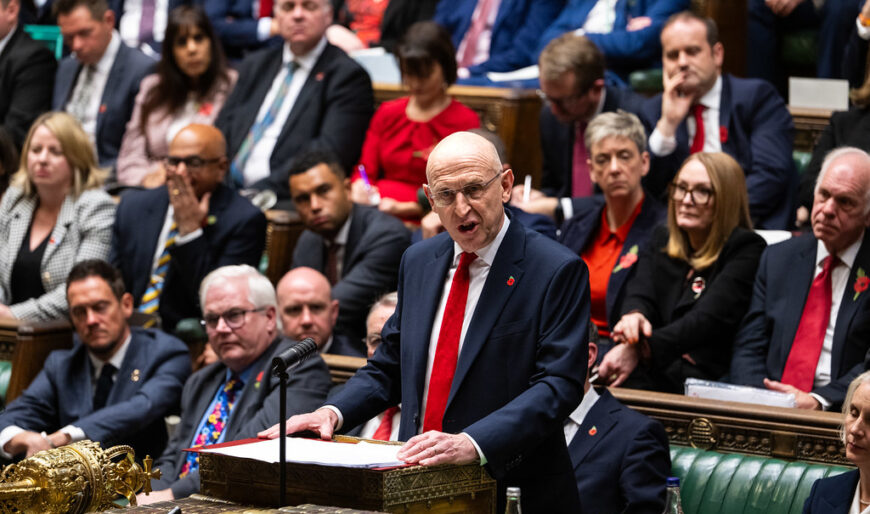
Trade union leaders gave a mixed response to Chancellor John Healey’s first Budget under the leadership of Andy Burnham. Some praised the plethora of “everyday fixes” announced by the Chancellor on Wednesday, while others felt that the Budget was a missed opprtunity to address more fundamental issues with the economy.
PCS General Secretary Fran Heathcote said:
The Chancellor talks about giving working people ‘breathing space’, but for our members, their pay has been squeezed for far too long. When your finances have been suffocated by years of rising costs and falling real-terms pay, breathing space simply isn’t enough, they need resuscitation.
Civil servants have continued to deliver the essential public services this country relies on while seeing the value of their wages eroded. A £100 household energy payment may provide some welcome short-term relief, but it cannot make up for years of pay erosion or address the underlying cost-of-living crisis.
The increase in the minimum wage is welcome, but it is shocking that so many of our members will have to rely on a statutory increase to see the littlest of improvement in their pay. What civil servants need is a significant, properly funded pay rise that begins to restore what they have lost. PCS is demanding an £18-an-hour minimum wage for civil servants, alongside a 10% pay remit properly funded by the Government.
When it comes to AI in the civil service, the Government’s plans need much closer scrutiny. This technology must improve services and make people’s jobs better, not become a pretext for further cuts to the civil service workforce. Public services would never improve if that became the case.
We recognise the importance of properly funding our national security, but the Government must also recognise the vital role played by civilian defence workers. They are an essential part of our defence capability and must not be expected to pay for increased investment through job cuts, outsourcing or attacks on their pay and conditions.
Ultimately, if this Budget really is about working people, the test will be whether it delivers a meaningful improvement to their lives. Our members need decent pay, secure jobs and investment in the public services they deliver – measures that would make a tangible difference to their lives and the services the public relies on.
UNISON general secretary Andrea Egan said:
From taxing the banks to grappling with energy bills, there’s much to welcome in this budget. Making the uplift in mileage rates permanent will make a real difference to public service workers.
But this was the government’s first chance to turn the prime minister’s historic ambition for a new economic settlement into action. On that count it falls short.
To improve ordinary people’s everyday lives in a way that lasts, the government needs to move beyond small fixes and deal with the fundamental causes of the miseries so many face.
There’s no doubt about what’s needed: undoing privatisation, ending the scourge of outsourcing and making the wealthiest pay their fair share to properly fund public services. It all follows from the prime minister’s powerful analysis.
The prime minister needs to trust his own ideas and defy the forces trying to bind him to economic orthodoxy. A confrontation with the vested interests that profit from the status quo can only be deferred for so long.
The union also welcomed the 3.9% increase to the national minimum wage and national living wage for 2.3 million workers. Andrea said: “The rise shows the chancellor’s determination to act on the cost of living.” But she added: “Good intentions aren’t enough to protect workers from sky-rocketing costs. Millions of workers are struggling to afford life’s essentials, from food to fuel and housing. They need pay rises which keep up with prices. At the least, the government should be setting the national living wage at the same level as the real living wage.
Usdaw general secretary Joanne Thomas said:
The first Budget under Andy Burnham’s leadership has delivered a host of everyday fixes that will help tackle the cost of living. The scrapping of standing charges on gas bills could save 60% of households an average of £45 a year. In addition, £1bn has been allocated to help poorer households struggling with soaring gas and electricity bills. This comes on the back of the Government already suspending VAT on electricity bills, which will be extended through winter and spring. This package of support on energy bills is welcome news for Usdaw members, a quarter of whom have had to cut back on heating or electricity use as a result of financial pressures.
The 3.9% increase to both the National Living Wage and National Minimum Wage will provide welcome relief to 2.3 million workers across the UK. However, it is disappointing that the Government appears to have moved away from the manifesto pledge to bring the “discriminatory” minimum wage for young people into line with the living wage for older workers.
The Carer’s Allowance cliff edge has also been abolished. Currently, unpaid carers lose their benefit if they earn a penny over the threshold. Under the Government’s plans, the cliff edge will change to a taper, meaning unpaid carers will lose £1 from their benefit for every £1 they earn over the threshold. This is something Usdaw has called for, and this change finally recognises the enormous contribution carers make to society with their willingness to provide care for their loved ones.
The Budget also included an extension of parental pay worth £388 per year to more than 150,000 additional parents, covering self-employed fathers and partners who have previously missed out. This goes some way to meet the needs of modern families.
Following lobbying from trade unions, the Chancellor announced an increase to the taxes paid by online retailers such as Amazon and eBay which could raise an additional £1bn. Lifting the small business threshold to £18,000 is a positive move, but to truly level the playing field with online giants means extending this relief to larger bricks-and-mortar retailers.
The economic reality is that the Chancellor is unable to increase rates of income tax, national insurance and VAT without breaking the Government’s manifesto commitments. However, the 3% surcharge on banks, who have had bumper profits on the back of higher interest rates, is only right – the wealthiest should pay their fair share of tax.
Community General Secretary Alasdair McDiarmid said:
Under difficult global conditions, the Chancellor has published a budget that follows in the traditions of the labour movement.
He has minimised damage to the wallets of working people and continued the path of re-balancing our economy so that all regions and nations benefit from our national prosperity.
Community welcomes the impactful measures that the Chancellor has prioritised, such as capping bus fares, removing charges on household energy bills and granting thousands of our members a £100 energy payment this winter. These will give millions of workers much-needed breathing space during a cost-of-living crisis.
The extension of Statutory Paternity Pay to 150,000 individuals is particularly welcome to our self-employed members who Community has long argued require greater social protections in times of need.
The Chancellor promised a budget that would provide breathing space. We have seen that budget delivered today.
We hope that future fiscal statements will build on the good work that has already been delivered by the Government to support our steel industry and drive the reindustrialisation agenda that this Government has championed. This must include decisive action to tackle the UK’s sky-high industrial energy costs.
What has been announced today will provide the sorely needed breathing space for workers, businesses and communities across our country.
Equity’s General Secretary Paul W. Fleming said:
We welcome the efforts of this new Labour administration to stand steadfastly on the side of working people.
Equity’s members earn an average of £15,300 a year from industry work and battle extreme cost pressures, precarity and poor housing. They will feel the benefit of announcements to tackle energy and food bills, and getting urgently needed social homes built.
Ensuring self-employed fathers and partners can spend time with new arrivals will have particular resonance; this is a right Equity has secured for members working across theatre, in excess of their statutory rights, and enhanced in the West End with our deal this year.
Equity is bucking the trend of low pay rises through our long-standing model of collective bargaining; delivering above inflation pay increases across theatre, film and TV as well as improved rights and a better work-life balance. As the government develops their 10-year plan, the Treasury would do well to look to Equity’s policy, strategy, and industrial successes. We are keen to work with the Chancellor to deepen and extend our collective bargaining model, tackle wasteful outsourcing at public service broadcasters, ensure tax reliefs are targeted towards good employers, and deliver new rights for the age of AI to strengthen our industrial bargaining position.
We remain confused at inconsistencies in rates reliefs across the creative industries, and the exclusion of accommodation costs from tax credits for touring theatre. We call on the Chancellor to review the relief system as a matter of urgency, and to commit to a return to a meaningful system of subsidy across live and recorded media.
We know that through devolution, the arts and entertainment can generate growth in every postcode. Mayors should have a critical coordination role in developing artistic production which supports economic regeneration, delivers new creative jobs, and strengthens and celebrates communities across the UK. We look forward to working in partnership with this government, national governments and mayors to achieve this.
Unite general secretary Sharon Graham said:
As I have been saying repeatedly in my meetings with the Prime Minister and the Chancellor, our members wanted two things from this budget: money in their pockets now, and a plan for investment and jobs.
Whilst there is some welcome news in this budget – including relief on energy bills and some investment in jobs – these are baby steps rather than a decisive leap forward.
The noose around the neck of wages, in the shape of frozen tax thresholds, must be dealt with. Started by the Tories in 2022, it is dragging workers into unfair tax bands and reducing disposable income. This cannot continue.’
This was the government’s first big chance to show real tangible change. The window to win back the working class will not stay open for long.
UCU general secretary Jo Grady said:
Today’s Budget has failed to deliver the action needed to address the crisis facing post-16 education. The Prime Minister will not deliver on his promises to invest in our young people unless he provides universities and colleges with the resources they desperately need.
We urgently need a sustainable funding plan for higher education, including a commitment to increased public funding, alongside a plan to achieve pay parity between further education lecturers and schoolteachers.
Real-terms funding per student available to universities fell by 35% between 2015-16 and 2025-26, while direct government funding for teaching has fallen by more than 80% since 2010-11. In the last three years alone over 30,000 jobs have been cut in our universities. The Chancellor says Labour has ‘rejected austerity’ but the truth is that in higher education, austerity has not gone away.
It is deeply concerning that cuts to public services remain on the agenda ahead of next year’s spending review. The Chancellor says “Labour is the party of public services”, but that must mean ruling out further cuts and setting out a credible plan to reverse decades of austerity that have damaged our social fabric.
It is wrong to commit to huge increases in spending on weapons and war while vital services struggle. The focus should be on raising living standards, delivering an industrial strategy that creates good jobs and investing in the education and skills that underpin economic prosperity.
Post-16 education cannot be left to the chaos of the market. If the government is serious about treating education as a public good, it must deliver proper funding, national planning, democratic accountability and stronger employment rights. Staff and students cannot afford another year of inaction.
Matt Wrack, General Secretary of NASUWT – The Teachers’ Union, said:
Teachers are still waiting for Andy Burnham to put his money where his mouth is. This budget will do little to support our severely underfunded education system or to lessen the real terms pay cuts faced by teachers up and down the country.
Measures to address broader cost of living concerns are welcome. If we are to tackle underachievement in education and some of the financial pressures faced by early career teachers, we must start with increasing the availability of affordable housing and reducing the cost of energy bills. Taxes on corporate profiteering and extreme personal wealth would allow the government to further support working people, and it is disappointing to see that such measures have not been included.
Further scrutiny will be needed for devolved allocation as it is unclear how devolution will affect local education funding in the long term. In the face of increased costs around SEND, local authorities will continue to require extra financial support. We cannot allow a gradually devolved funding system to push more schools into multi-academy trusts, especially when these trusts face little accountability in terms of spending and profiteering.
Daniel Kebede, general secretary of the National Education Union, said:
The Chancellor has failed to acknowledge that investment in our schools and colleges is a necessity, not a choice. Since 2010 schools have had their spending power cut by £4.5bn. They are at breaking point.
The impact on children and young people’s education is shocking. The list is endless, from the SEND funding crisis to the dilapidated state of classrooms, cuts to staffing and the courses on offer. Heads, teachers, support staff and parents are sick and tired of having to accommodate successive governments’ refusal to fund our education system properly.
Staff are trying their best to hold things together, but they are swimming against the tide.
Money can be found. The government must halt plans to claw back the £3.3bn from reduced employer contributions to the Teachers’ Pension Scheme and keep the money in school budgets.
The value of teacher pay has already been cut by around a fifth since 2010, while support staff pay has fallen by around 26 percent in real terms over the same period with many facing in-work poverty due to low wages and term-time only contracts.
Teacher pay cuts drive teacher shortages and therefore damage our education service. Investing in the skills of our children and young people is vital to our economy, so the government must provide the investment needed to properly value, recruit and retain the teachers we need.
To put their money where their mouth is, the government has now to deliver the additional investment needed for schools. That is the only way to ensure every child has the education they deserve.
We know that misogyny, sexual harassment and sexual violence have a devastating impact on the lives of too many girls, affecting every aspect of their lives including their education. The additional money to address the issue not just in schools but in wider society is welcome.


Related news
Unions respond to Burnham’s first conference speech as Labour leader & PM

School teachers’ pay: Joint union response to Secretary of State