Spycops inquiry condemned as “fundamentally flawed” in statement by blacklisted workers
Statement catalogues 10 years of missed opportunities and broken promises in relation to blacklisting
Spycops inquiry condemned as “fundamentally flawed” in statement by blacklisted workers
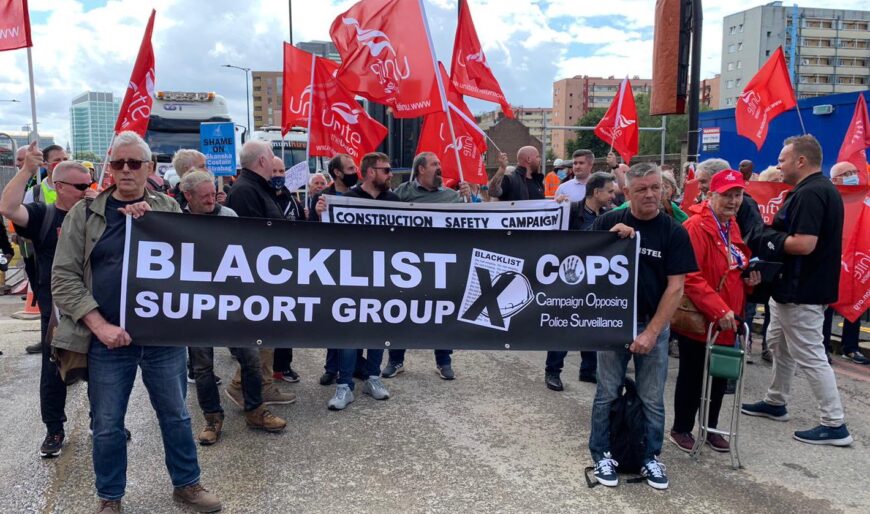
The Undercover Policing Inquiry is failing in its duty to examine the extent of state involvement in the blacklisting of construction workers. The ‘spycops’ public inquiry restarted evidence hearings this week and has been described as “fundamentally flawed” by the Blacklist Support Group (BSG).
The lawyer representing the blacklisted workers, Imran Khan KC, called for the close relationship between undercover police and businesses involved in blacklisting to be examined, including the roles played by Special Branch, the Metropolitan Police, MI5 and other state bodies.
Khan said the BSG hoped that alleged actions of undercover officers, such as one inciting the petrol bombing of a charity shop by activists and another distributing flyers calling for a union convener to be sacked in 1995, would be investigated.
But he said the failure to mention the practice of blacklisting in the inquiry’s 2023 interim report suggested that its approach had been “superficial, at best”.
The opening BSG statement for the inquiry’s Tranche 3 hearings begins with:
Undercover police officers infiltrated and spied on trade unions. SDS reported on union meetings, union activists, union campaigns, and industrial disputes. For decades, police and security service records were used to blacklist trade union and leftwing political activists from employment. Through official and unofficial routes, the police intelligence was disseminated to government departments, major private sector employers and the unlawful blacklisting bodies; the Economic League and the Consulting Association.
The statement goes onto catalogue 10 years of missed opportunities and broken promises in relation to blacklisting, including highlighting how intelligence gathered by undercover police is used to provide state organised vetting for employers known as ‘List X companies’.
The statement continues:
The failure to fully investigate blacklisting is either a remarkable lack of curiosity, or an intentional self-imposed restriction of the Inquiry’s terms of reference. Either way it is against the public interest and is a failure to fulfil the Inquiry’s terms of reference as laid out by Parliament.
The Blacklist Support Group’s opening statement is published on the inquiry’s website as part of the submission by Khan, who also represents Baroness Doreen Lawrence OBE, Suresh Grover and the Monitoring Group.
The full statement can be read here.


Related news
Unions send Open Letter criticising the spycops inquiry approach to blacklisting
TUC General Council statement – Special Congress 2023