Ricardo Buendia

Ricardo is a lecturer and Course Director in Employment Law at the Law Department, School of Social Sciences, University of... Read more »

The UK must resist the temptation to follow the authoritarian path of unilateralism.
 21 Jan 2026|
Introduction: Why Minimum Service Laws Matter
When the UK’s Conservative government introduced the Strikes (Minimum Service Levels) Act 2023, it claimed to be bringing the UK in line with “modern European nations.” During strikes in essential services — the Conservative argument goes — shouldn’t the public be guaranteed a basic level of care and safety? However, beneath this common-sense veneer lay a deeper question: how far can a government go in curbing the right to strike without undermining democracy itself?
The Act was apparently short-lived. The Labour government already promised to repeal it through the Employment Rights Act. Yet the debate is far from over. Minimum service levels (MSLs) remain a tempting tool for governments facing industrial unrest to carry out an expansive project to silence opposing voices, in the case of minimum services, to protect the so-called ‘silent majority’. This can be done in various ways, including a careful design to silence workers’ voices while keeping a façade of legality. To understand how such a strategy pans out, in a recent article, I discuss how the latest Conservative government brought back in the UK an authoritarian narrative tested in Pinochet’s dictatorship.
The UK Context: Strikes and the Birth of the MSL Act
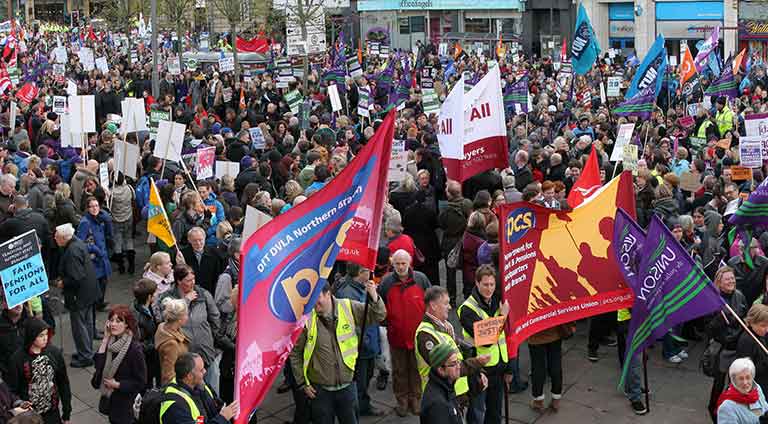
The backdrop to the MSL Act was the cost-of-living crisis of 2022–2023, which triggered the largest wave of strikes in decades. Rail workers, postal staff, teachers, civil servants, and NHS employees all walked out. According to the Office for National Statistics, 2.47 million working days were lost between June and December 2022, and nearly one in five people had their travel disrupted during the Christmas season.
Faced with mounting public frustration, the Conservative government framed the MSL Act as a pragmatic solution. Grant Shapps, then Business Secretary, argued that the law would balance the right to strike against the public’s need for lifesaving care, citing Spain, France, and Italy as examples. The International Labour Organization (ILO), he claimed, endorsed minimum service levels as a proportionate measure.
On paper, the Act applied to six sectors: health, fire and rescue, education, transport, nuclear decommissioning, and border security. Employers could issue work notices compelling named employees to work during strikes. Trade unions were legally obliged to ensure compliance—or face fines of up to £1 million and loss of unfair dismissal protection for striking workers.
The Authoritarian Undercurrent
Critics were quick to point out that the Act was not about balance—it was about control. Prestigious Labour Law scholars like Professor Keith Ewing described it as “authoritarian, illiberal, and illegal.” The authoritarian markers of the Act can be framed in three aspects.
As Professor Keith Ewing rightly observed, this was unprecedented in a liberal democracy: a legal duty on unions to undermine their own strikes. The Act didn’t just regulate minimum services during industrial action—it weaponized the law against collective bargaining and strike.
Pinochet’s Chile: A Mirror Image?
Such authoritarian traces of the Act should not be found in the ‘Modern European Nations’ that the former Government sought to be compared, but with more authoritarian regimes like the Chilean dictatorship led by Augusto Pinochet. After the 1973 coup, Pinochet dismantled unions and imposed the Plan Laboral—a neoliberal labour code designed by José Piñera, one of the infamous “Chicago Boys.” The Plan Laboral:
While the UK Government didn’t resort to such degree of violence, the logic was strikingly similar: government and employer unilateralism was justified by vague public interest claims. Both systems treated strikes as a threat to order rather than a legitimate bargaining tool.
Democratic Chile’s Journey: Lessons in Social Dialogue
Chile’s return to democracy in 1990 didn’t erase Pinochet’s legacy overnight. For years, employers could still replace workers during strikes, and ministers could ban strikes in broad circumstances without credible tools to oppose by trade unions or workers in general. But change came through judicial and legislative approaches more akin to international labour standards.
In 2014–2015, Chile’s Supreme Court issued landmark rulings (Promolinks and Carvajal Empaques) banning both internal and external replacement of workers. The Court invoked international treaties, including the International Covenant on Economic, Social and Cultural Rights, and declared the right to strike a fundamental human right.
Building on this, the 2016 Labour Reform:
The result? Minimum services became a matter of dialogue, not diktat. While Chile still struggles with broad constitutional restrictions on the right to strike for public and council workers, its trajectory shows that authoritarian labour laws can be dismantled—and replaced with systems that respect workers’ voices.
Repeal and the Road Ahead: ERA 2025
The UK’s Employment Rights Act 2025 scrapped the MSL Act and introduced the most ambitious package of trade union rights in a generation. However, there remains the question of whether there should or will be a future minimum service level regulation. Three factors make a regulatory comeback unlikely:
Conservative leader Kemi Badenoch has already floated proposals to prohibit strikes by NHS doctors, echoing a strategy of expanding strike bans rather than negotiating minimum services.
Voluntary vs. Statutory: A Better Way Forward
Minimum service levels aren’t inherently bad. The ILO recognizes them as a legitimate alternative to total strike bans—if implemented through social dialogue. Britain has a tradition of voluntary arrangements: for example, the TUC’s 1979 Guide urged unions to maintain essential services during disputes to avoid “exceptional hardship.” During the 2025 doctors’ strike, the British Medical Association agreed to cover mass casualty events without legal compulsion.
This is the path forward: consent, not coercion. Minimum services should be negotiated, not imposed. Disputes should be resolved by independent bodies, not ministers or employers acting unilaterally.
Lessons for the UK
The Chilean experience offers a stark warning: authoritarian labour laws don’t create peace—they breed conflict. Pinochet’s Plan Laboral silenced unions but failed to deliver lasting stability. Democratic Chile shows that incorporating workers’ voices strengthens social dialogue and reduces industrial strife.
Britain should heed this lesson. The repeal of the MSL Act was a victory for democracy at work—but vigilance is essential. Minimum service laws can be tools for cooperation or weapons of control. The difference lies in how they are made and crucially whether social partners like trade unions have a voice in the process.
Conclusion: Dialogue Over Diktat
The right to strike is not an inconvenience—it’s a cornerstone of democratic labour relations. Minimum service levels can coexist with this right, but only if they respect proportionality, participation, and independence. The UK must resist the temptation to follow the authoritarian path of unilateralism. Instead, it should embrace the principle that social peace is built through dialogue, not decree.
Call to action
Policymakers: If you revisit minimum service laws, do it through tripartite dialogue—government, employers, and unions at the same table.
Unions: Keep demonstrating that voluntary agreements work.
Employers: Recognize that coercion backfires; collaboration pays.
Ricardo is a lecturer and Course Director in Employment Law at the Law Department, School of Social Sciences, University of... Read more »