Trade unions comment on teacher pay award & demand pay rises are fully funded
Government confirms plans for a multi-year settlement in long awaited response to STRB

The government has published its long-awaited response to the school teachers’ review body (STRB) report for 2026 – even though the report itself is yet to be published.
The government’s response confirms a pay rise of 3.5% from September for all school teachers. Some of those on the unqualified pay scale will see larger rises, as the government plans to lift the bottom of the scale by 5%.
Teachers will then receive a further 3% pay rise from September 2027.
Despite teaching unions threatening to strike unless the pay rise was fully funded, the government has stated that schools will be expected to fund around a third of teacher and support staff pay awards from existing budgets.
Support staff were recently offered a rise of 3.3%, back-dated to April.
“Schools, like the rest of the public sector, will need to continue to play their part and will be expected to find the first 1% of each pay award through continued efforts to maximise value from their budgets,” said the Department for Education.
Commenting, Daniel Kebede, general secretary of the National Education Union (NEU), said:
Pressure from the NEU has forced the government beyond its original pay and funding offer. But let us be clear: a partially funded settlement still means cuts to education, and the NEU will never accept that.
Schools are being asked to find £460 million from budgets already at breaking point. This is the equivalent of 8,300 school staff: 3,900 teachers and 4,400 support staff. Ministers cannot claim to want more teachers while overseeing such a drastic reduction in numbers next year.
In Makerfield, in Andy Burnham’s constituency, that means 40 schools being forced to find £866,842 collectively from their own budgets simply to meet the government’s requirement to fund part of this pay award.
Teachers, leaders, support staff and parents know the truth: underfunding damages learning, narrows opportunity, drives staff shortages and pushes workload beyond breaking point. Investment in education is investment in the future of this country.
At a time of rising defence spending, government must answer a simple moral question: why is there always money for conflict, but not enough for childhood?
If fiscal rules block investment in schools, staff and children’s futures, then those rules must change. Economic credibility cannot be built on crumbling classrooms and a workforce pushed beyond breaking point.
With inflation set to rise, members know this offer is not the decisive shift needed to reverse real-terms pay cuts since 2010 or restore the competitiveness of teacher pay.
The government’s action on CEO pay is a start, but it is not enough. It will not be retrospective, and the waste and inequality in the academies system must be tackled through a fair, transparent and enforceable shared pay framework.
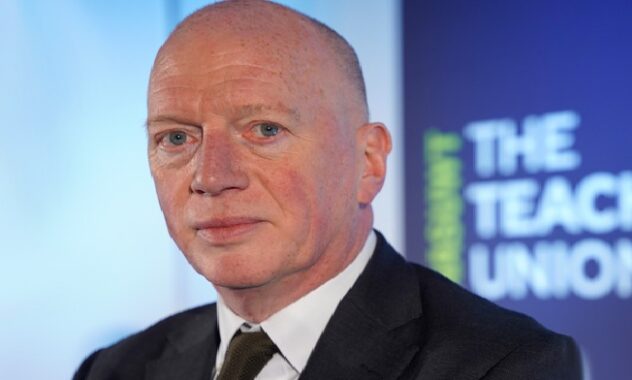
Matt Wrack, General Secretary of NASUWT, said:
The proposals on teacher pay fall well short of what is required to support the continued delivery of a world class education service.
NASUWT argued for a fully funded, restorative pay award that would begin to reverse years of real-terms pay erosion and help tackle the recruitment and retention crisis affecting schools across England. The Government has failed to deliver that ambition.
Instead, schools will once again be expected to fund the first 1% of the pay award from existing budgets, which are already at breaking point. At a time when many schools are reducing staffing, cutting educational provision and making redundancies to balance their budgets, this will place even greater pressure on school finances. Teachers should not have to foot the bill for their own pay award through cuts to the education service. Cutting jobs in schools will exacerbate the excessive hours and workload already forcing too many out of the teaching profession.
We have long campaigned for a cap on academy CEO pay and the announcement of measures to introduce greater oversight of salaries is a welcome step in the right direction. However, the proposed curbs will not apply retrospectively and will therefore do nothing to address the profiteering and excessive salaries already in place.
The Government has failed to offer the investment and solutions needed to put our schools on a sustainable footing for the future and ensure funding is focused on the frontline where it is most needed. We will be carefully considering our next steps in light of today’s announcement and all options, including possible industrial action, remain on the table.
Paul Whiteman, general secretary of school leaders’ union NAHT, said:
We are pleased the review body and government have listened to NAHT and other unions, agreeing that an above-inflation pay uplift is required.
He said while “there remains some way to go to achieve our aim of restoring the value of pay to 2010 levels”, the uplift “represents another step in the right direction so long as we don’t see a big spike in inflation”.
GMB, who represent many school support staff, has responded to a pay offer made to teachers today and proposed caps on CEO pay at Multi Academy Trusts.
On teachers pay Stacey Booth, GMB National Officer, said:
GMB members have already rejected the 3.3 per cent offered by the local government employers. It’s simply not enough to address the years of underfunding in schools and a cost of living crisis.
For hard-working, underpaid school support staff to hear today teacher colleagues will receive a higher pay offer than them is abhorrent and really rubs salt into the wound.
But local government employers will receive more money as a result of this announcement – GMB calls on them to make sure it goes to the people who need it most: school support staff.
On academy CEO pay, she said:
Limiting how much academy trusts can pay executive pay is common sense and common decency. CEO pay has climbed to exorbitant levels, while our members in those trusts have faced cuts and redundancies – it’s a disgrace, frankly.
GMB has long-campaigned for a cap on academy CEO pay so this is a welcome first step. But the proof will be in the pudding and it will be interesting to see not only how many applications for high pay are received, but more importantly how many are approved.


Related news
Unions respond to Burnham’s first conference speech as Labour leader & PM

School teachers’ pay: Joint union response to Secretary of State