

Case Law Update 4 March 2026 – Manchester
Case Law Update 04 March 2026 Blog
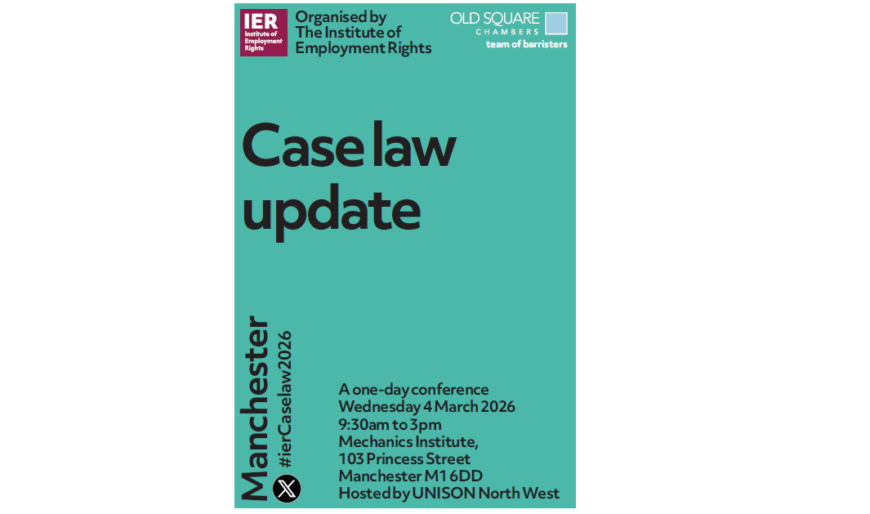
Activists from across the North West’s trade-union movement were brought up to date on developments in employment case-law at IER’s ever-popular seminar, hosted by UNISON Northwest and presented by specialist employment-law barristers from Old Square Chambers.
Welcoming delegates to Manchester’s historic Mechanics’ Institute, IER Director James Harrison lamented that the recently passed Employment Rights Act would not be as transformative as it should have been, with missed opportunities to establish a single worker status and introduce sectoral collective bargaining.
While the Act had made important steps for individual rights, it had not fundamentally loosened the legal constraints that had led to the historic decline in trade-union effectiveness, and the movement was already gearing up to campaign for a second bill to address collective rights, James noted.
Employment-law barrister Madeline Stanley updated us on key cases relating to worker status, whistleblowing and trade-union rights.
The case of Maritime and Coastguard Agency v Groom ([2026] EWCA Civ 6) had centred on interpretation of the status of ‘worker’ provided by section 230(3)(b) of the Employment Rights Act 1996, under which Martin Groom, a volunteer Coastguard rescue officer, had asserted his right to be accompanied in a disciplinary hearing.
The employer had argued that Groom, as a volunteer, was not a worker, but the Court of Appeal – following ET and EAT hearings – ruled that Groom was indeed a worker, given that there was a wage-work bargain, in that he was entitled to remuneration, as well as a mutuality of obligation which bound him to follow reasonable management instructions.
Discussing Rice v Wicked Vision ([2025] EWCA Civ 1466), which began as a claim for unfair dismissal for whistleblowing under section 103A of the Employment Rights Act, Madeline highlighted the complex law surrounding whistleblowing and the anomalies in law between ‘dismissal’ and ‘detriment’, which had resulted in the case being referred to the Supreme Court, where it is listed to be heard on 21 May. Watch this space!
Turning to Sullivan v Isle of Wight ([2025] IRLR 520), Madeline noted that the case had underlined that applicants for jobs were only protected for earlier protected disclosures if they were applying for posts in the National Health Service.
Ms Sullivan had complained to the Employment Tribunal that the Council had failed to offer her a job because she had made a protected disclosure. However, section 47B of the Employment Rights Act 1996 applies to workers (and not applicants) and, Madeline noted, an attempt to amend the legislation in Parliament a decade ago had failed.
At appeal, Ms Sullivan had argued that the legislation was incompatible with Article 10 of the European Convention on Human Rights, but the court disagreed.
Finally, Madeline pointed to Ryanair DAC v Morais et al ([2025] ICR 863), which had highlighted issues connected with blacklisting and the rights of workers not to suffer detriment for taking part in trade-union activity.
After trying unsuccessfully to win an injunction against strike action by pilots, Ryanair had unilaterally withdrawn concessionary travel benefits from them, and a claim was made against the company under the Employment Relations Act 1999 (Blacklists) Regulations 2010.
Regulation 3 holds that a prohibited list would include one that “contains details of persons who…have taken part in the activities of trade unions” compiled “with a view to being used…for the purposes of discrimination…in relation to the treatment of workers.”
Bang to rights, you’d be forgiven for thinking – but section 146 of the Trade Union and Labour Relations (Consolidation) Act 1992 (TULRCA) muddies the waters in referring to the right not to suffer detriment from taking part in the activities of a trade union at an appropriate time.
But, Madeline pointed out, the new Employment Rights Act 2025 potentially clarifies matters by introducing a new provision to TULRCA, section 236A, which specifically prohibits detriment on grounds of industrial action.
Daniel Hallström took us through topical unfair-dismissal cases, starting with the latest on Hewston v Ofsted ([2025]ICR1270), in which the claimant, who had been employed as an inspector, had been dismissed for alleged gross misconduct for touching a pupil, despite the employer agreeing there had been no safeguarding issue.
Readers may well be familiar with the case as it has proceeded through ET and EAT, but Daniel recommended study of the Court of Appeal judgment, which upheld the EAT’s ruling that Mr Hewston had been unfairly dismissed, as it gave “a helpful and authoritative restatement of familiar principles” applying to unfair ‘conduct’ dismissals.
He added that it was also useful on the limits of an employer’s ability to use an employee’s response or ‘attitude’ towards charges, or alleged loss of trust or reputational harm to ‘bump up’ the seriousness of charges where the original conduct did not in itself warrant dismissal.
Chand v EE Limited ([2026] EAT 17) was a case that underlined the need to keep sight of the actual reasons for dismissal, Daniel noted.
The claimant had been summarily dismissed, after 16 years’ service, for four counts of alleged fraud after she had failed to adhere to company policy on customer ID and credit checks. Ms Chand had been under emotional stress due to caring responsibilities and accepted she had been negligent.
The original ET had concluded that the employer had been unreasonable in three of the four incidents, but that in one Ms Chand had committed an ‘egregious’ breach of policy, but not fraud, and that that ‘catastrophic error of judgement’ was conduct that did warrant dismissal.
The EAT looked at the actual reason for dismissal, which was that all four incidents had been fraudulent, and concluded that the employer did not have reasonable grounds for believing that the claimant was guilty of conduct for which she was actually dismissed.
However, Daniel pointed out that what the employer might fairly have done would become relevant at the remedy stage, and Ms Chand’s victory could turn out to be a pyrrhic one as a significant – if not 100% – Polkey reduction was on the cards, given the likelihood that she would have been dismissed in any case.
A delay in conducting an investigation might render an otherwise fair dismissal unfair, noted Daniel in discussing O’Brien v Cheshire and Wirral Partnership NHS Foundation Trust ([2025] EAT 156).
Ms Obrien, a ward manager, was dismissed in March 2021 because she was found not to have worked her contracted hours on occasions between September and December 2018, and had on one occasion claimed overtime for hours not worked.
Although the matter had been brought to managers’ attention in January 2019, the following investigation did not produce a report until November 2020, with the disciplinary following in March the following year.
The initial ET had rejected an unfair dismissal claim, finding that the initial delay, while ‘unfortunate’ did not make the dismissal unfair, although it did uphold a wrongful dismissal claim.
The EAT decided that the delay was significant, and that the delay could not be reconciled with the finding that the employer had not ‘unreasonably’ breached the ACAS Code of Conduct, and remitted the unfair dismissal claim for further consideration by the ET.
Zen Internet v Stobart ([2025] EAT 153) was a useful case for discussing Polkey criteria –the mechanism by which potential Tribunal awards might be reduced to reflect a claimant’s own culpability – given the EAT judgment’s comprehensive survey of Polkey case-law, Daniel said.
The case itself turned on the dismissal of a chief executive officer by the business owner for alleged performance concerns, despite him receiving positive performance reviews.
The ET concluded that the dismissal was unfair, citing the employer’s failure to observe its own policies and procedures, but also indicated that if a fair procedure had taken place dismissal would have followed in any case. That decision was upheld by the EAT, which also pointed out that there were potential circumstances in which strict adherence to capability procedures might not always be required.
Another useful case for understanding the criteria used in Polkey reductions was
Pal v Accenture (UK) Limited ([2026] EAT 12), in which the ET had found a dismissal unfair for failure to abide by procedures, but had also made a 100% deduction on the grounds that the claimant would have been dismissed had the process followed been fair.
Noting that the EAT had remitted the case back to the ET, Daniel pointed to the EAT’s instruction to weigh whether the employer would or might have decided to dismiss had its policy been adhered to, and if such dismissal might potentially be fair.
Carl Rix gave delegates a run-down of notable recent discrimination cases, starting with Stedman v Haven Leisure Limited ([2025] IRLR 738), which illustrated the complexities in assessing whether an individual’s neurodiversity might amount to disability.
A diagnosis of a neurodiverse condition – in this case autism and ADHD – would not automatically lead to an individual being disabled within the meaning of section 6 of the Equality Act 2010 – and in this case the original ET deemed that the claimant was not.
Carl cited the judgment in the successful appeal, which said the Tribunal “still needs to consider what it was that led the clinician to make the diagnosis in the claimant’s case, and to make findings about the claimant’s ability to carry out day-to-day activities.” The case was remitted to the ET.
In Leicester City Council v Parmar ([2025] IRLR 782) both the EAT and Court of Appeal upheld an ET decision that Ms Parmar had been discriminated against on the grounds of race after she showed that she had been dealt with more harshly than white comparators.
The case involved an ill-defined investigation begun by a manager after complaints were made by three white colleagues but subsequently dropped by another as ‘no case to answer’; failure to disclose documentation or to particularise charges, and evidence that white employees had not been investigated.
Disability discrimination was the subject of South Gloucester Council v Hundal ([2024] EAT 140), in which a social worker had brought a claim under section 15 of the Equality Act 2010 after having her agency contract terminated as a result, she alleged, of her endometriosis.
Although the EAT dismissed her claim of direct discrimination, it upheld her claim that the dismissal amounted to discrimination arising from her disability. The respondent had failed to show that the dismissal was a proportionate means to achieve a legitimate aim and should have attempted to put reasonable adjustments in place.
In Hindmarch v North-East Ambulance NHS Foundation Trust, ([2025] IRLR 672), the EAT upheld an original ET decision to reject a claim of failure to make reasonable adjustments after the employer dismissed on ill-health grounds an ambulance care assistant who suffered from anxiety and depression exacerbated by Covid-19 and had refused to return to driving unless provided with an FFP3 mask.
The ET had found that there was no prospect that the provision of an FFP3 mask rather than FFP2 would have alleviated his anxiety, and the decision was upheld by the EAT, confirming that if there was no chance that an adjustment would help to ameliorate a disadvantage it would not be reasonable to expect the employer to make it.
Carozzi v University of Hertfordshire ([2025] IRLR 179) centred on a claim under section 26 of the EqA 2010 for harassment relating to race, in which the EAT ruled that the original ET had erred in finding that comments about her accent did not amount to harassment as it had not been motivated by her race.
However, the wording of section 26 establishes that harassment is unwanted conduct related to a relevant protected characteristic that has the purpose or effect of violating dignity or creating an intimidating, degrading humiliating or offensive environment
In this case the purpose – or ‘mental’ element may not have been present, but the EAT ruled that it did have the effect of harassment, Carl said.
Another harassment case – Windsor Clive Primary School v Forsbrook ([2024] EAT 183) – illustrated the need for a claimant to show that the alleged harassment was related to a protected characteristic – in this case disability.
The claimant had mistakenly been issued a stage-two absence notice, which was withdrawn on discovery. The EAT had ruled that the ET had erred in accepting this as harassment relating to disability, as the claimant had not shown a connection between the employer’s conduct and the claimant’s disability. The case was remitted to the ET.
Finally, in Jones v Secretary of State for Health and Social Care ([2025] IL 28), Carl discussed the criteria for granting a ‘just and equitable’ extension of the usual three-month time limit for submitting a Tribunal claim.
The claimant was an unsuccessful job applicant who brought an ‘out-of-time’ race-discrimination claim, and the original ET said it was not equitable to extend the deadline, a decision upheld by the EAT
However, the Court of Appeal overturned the decision, noting the respondent’s failure to provide the claimant with relevant information within the time-limit, and that the ET had attached erroneous importance to the fact that the claimant had been ‘suspicious’ before the time-limit had passed, pointing out that claims should not be brought on suspicion, but on evidence – which in this case the respondent had withheld.
Health warning: the above are notes from an interested trade unionist, not a lawyer – you can read the actual judgments using the references above – and look out for the latest issue of IER’s Labour Law Highlights, written by the Old Square Chambers team and coming out shortly, and posted free to subscribers.
Derek Kotz
Download event documents
- Worker-Status-Madeline-Stanely.pdf - 285.71 KB
- Unfair-Dismissal-Daniel-Hallstrom.pdf - 381.61 KB
- Discrimination-Carl-Rix.pdf - 338.62 KB






