

Case Law Update 25 February 2026 – London
An event aimed at exploring the relationship between labour law and the workplace.
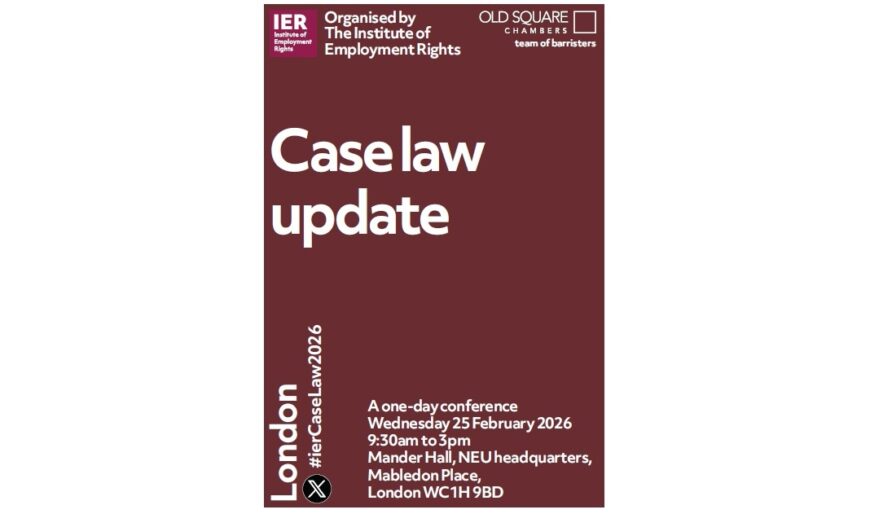
Case Law Update London 25 February Blog
Activists from the trade-union movement were brought up to date on developments in employment case-law at IER’s ever-popular seminar, hosted by the NEU at Hamilton House and presented by specialist employment-law barristers from Old Square Chambers.
Welcoming delegates to London’s Hamilton House, IER Director James Harrison lamented that the recently passed Employment Rights Act would not be as transformative as it should have been, with missed opportunities to establish a single worker status and introduce sectoral collective bargaining.
While the Act had made important steps for individual rights, it had not fundamentally loosened the legal constraints that had led to the historic decline in trade-union effectiveness, and the movement was already gearing up to campaign for a second bill to address collective rights, James noted.
Annie Davis updated us on key cases relating to worker status. Annie discussed how a taxi driver can be self-employed in the case of Johnson v GT Gettaxi [2024]. This case shows the relevancy of applying the statutory wording of Section 23 of the Employment Rights Act to employment status.
Moving on to Lutz v (1) Ryanair DAC; (2) Storm Global Ltd (2025) EWCA Civ 849, [2025] I.C.R 1448. This provided further clarification on the meaning of temporary for the purposes of Regulation 3 of the Agency Workers Regulations 2010.
Annie also took us through AB Grafters v Group Ltd [2025] EAT 126. The tribunal looked at whether an act of harassment took place in the course of employment. The employer could be found liable if there was a significant nexus or connection to work.
Ter-Berg v Malde and Hancock [2025] shows that an ET finding that a claimant was not an employee does not automatically prohibit them from being a worker.
Tom Kirk took us through topical unfair-dismissal cases, starting with the latest on Hewston v Ofsted ([2025] ICR1270), in which the claimant, who had been employed as an inspector, had been dismissed for alleged gross misconduct for touching a pupil, despite the employer agreeing there had been no safeguarding issue.
Readers may well be familiar with the case as it has proceeded through ET and EAT, but Tom recommended study of the Court of Appeal judgment, which upheld the EAT’s ruling that Mr Hewston had been unfairly dismissed, as it gave “a helpful and authoritative restatement of familiar principles” applying to unfair ‘conduct’ dismissals.
A delay in conducting an investigation might render an otherwise fair dismissal unfair, noted Tom in discussing O’Brien v Cheshire and Wirral Partnership NHS Foundation Trust ([2025] EAT 156).
Ms Obrien, a ward manager, was dismissed in March 2021 because she was found not to have worked her contracted hours on occasions between September and December 2018, and had on one occasion claimed overtime for hours not worked.
Although the matter had been brought to managers’ attention in January 2019, the following investigation did not produce a report until November 2020, with the disciplinary following in March the following year.
The initial ET had rejected an unfair dismissal claim, finding that the initial delay, while ‘unfortunate’ did not make the dismissal unfair, although it did uphold a wrongful dismissal claim.
The EAT decided that the delay was significant, and that the delay could not be reconciled with the finding that the employer had not ‘unreasonably’ breached the ACAS Code of Conduct, and remitted the unfair dismissal claim for further consideration by the ET.
Zen Internet v Stobart ([2025] EAT 153) was a useful case for discussing Polkey criteria –the mechanism by which potential Tribunal awards might be reduced to reflect a claimant’s own culpability – given the EAT judgment’s comprehensive survey of Polkey case-law, Tom said.
The case itself turned on the dismissal of a chief executive officer by the business owner for alleged performance concerns, despite him receiving positive performance reviews.
The ET concluded that the dismissal was unfair, citing the employer’s failure to observe its own policies and procedures, but also indicated that if a fair procedure had taken place dismissal would have followed in any case. That decision was upheld by the EAT, which also pointed out that there were potential circumstances in which strict adherence to capability procedures might not always be required.
Maryam Shah gave delegates a run-down of notable recent discrimination cases, starting with Higgs v Farmor School. This case highlighted how the direct dismissal of an employee because they expressed a religious or protected belief is unlawful direct discrimination. If the dismissal was motivated by something objectional in the expression of views this would have to be a proportionate response.
Thomas v Surrey and Borders Partnership NHS Foundation Trust. The alleged belief was described as English nationalism. The respondent argued that the belief was more than that though. A preliminary hearing found that the Claimant belief was not protected under the equality act. The EAT clarified that the Claimants view of English nationalism which allows no place in British society for Islam took it outside the protected beliefs.
Stedman v Haven Leisure Limited ([2025] IRLR 738), which illustrated the complexities in assessing whether an individual’s neurodiversity might amount to disability.
A diagnosis of a neurodiverse condition – in this case autism and ADHD – would not automatically lead to an individual being disabled within the meaning of section 6 of the Equality Act 2010 – and in this case the original ET deemed that the claimant was not.
Carl cited the judgment in the successful appeal, which said the Tribunal “still needs to consider what it was that led the clinician to make the diagnosis in the claimant’s case, and to make findings about the claimant’s ability to carry out day-to-day activities.” The case was remitted to the ET.
Carozzi v University of Hertfordshire ([2025] IRLR 179) centred on a claim under section 26 of the EqA 2010 for harassment relating to race, in which the EAT ruled that the original ET had erred in finding that comments about her accent did not amount to harassment as it had not been motivated by her race.
However, the wording of section 26 establishes that harassment is unwanted conduct related to a relevant protected characteristic that has the purpose or effect of violating dignity or creating an intimidating, degrading humiliating or offensive environment
In this case the purpose – or ‘mental’ element may not have been present, but the EAT ruled that it did have the effect of harassment, Carl said.
The claimant had mistakenly been issued a stage-two absence notice, which was withdrawn on discovery. The EAT had ruled that the ET had erred in accepting this as harassment relating to disability, as the claimant had not shown a connection between the employer’s conduct and the claimant’s disability. The case was remitted to the ET.
Finally, in Jones v Secretary of State for Health and Social Care ([2025] IL 28), Carl discussed the criteria for granting a ‘just and equitable’ extension of the usual three-month time limit for submitting a Tribunal claim.
The claimant was an unsuccessful job applicant who brought an ‘out-of-time’ race-discrimination claim, and the original ET said it was not equitable to extend the deadline, a decision upheld by the EAT
However, the Court of Appeal overturned the decision, noting the respondent’s failure to provide the claimant with relevant information within the time-limit, and that the ET had attached erroneous importance to the fact that the claimant had been ‘suspicious’ before the time-limit had passed, pointing out that claims should not be brought on suspicion, but on evidence – which in this case the respondent had withheld.
Health warning: the above are notes from an attendee not a lawyer – you can read the actual judgments using the references above – and look out for the latest issue of IER’s Labour Law Highlights, written by the Old Square Chambers team and coming out shortly, and posted free to subscribers.
Download event documents
- Employment-Status-Annie-Davis.pdf - 358.97 KB
- Unfair-Dismissal-Tom-Kirk.pdf - 493.43 KB
- Discrimination-Maryam-Shah.pdf - 213.01 KB






